Vietnam Association of Diabetes and Endocrinology – VADE Vietnam Association of Diabetes and Endocrinology – VADE
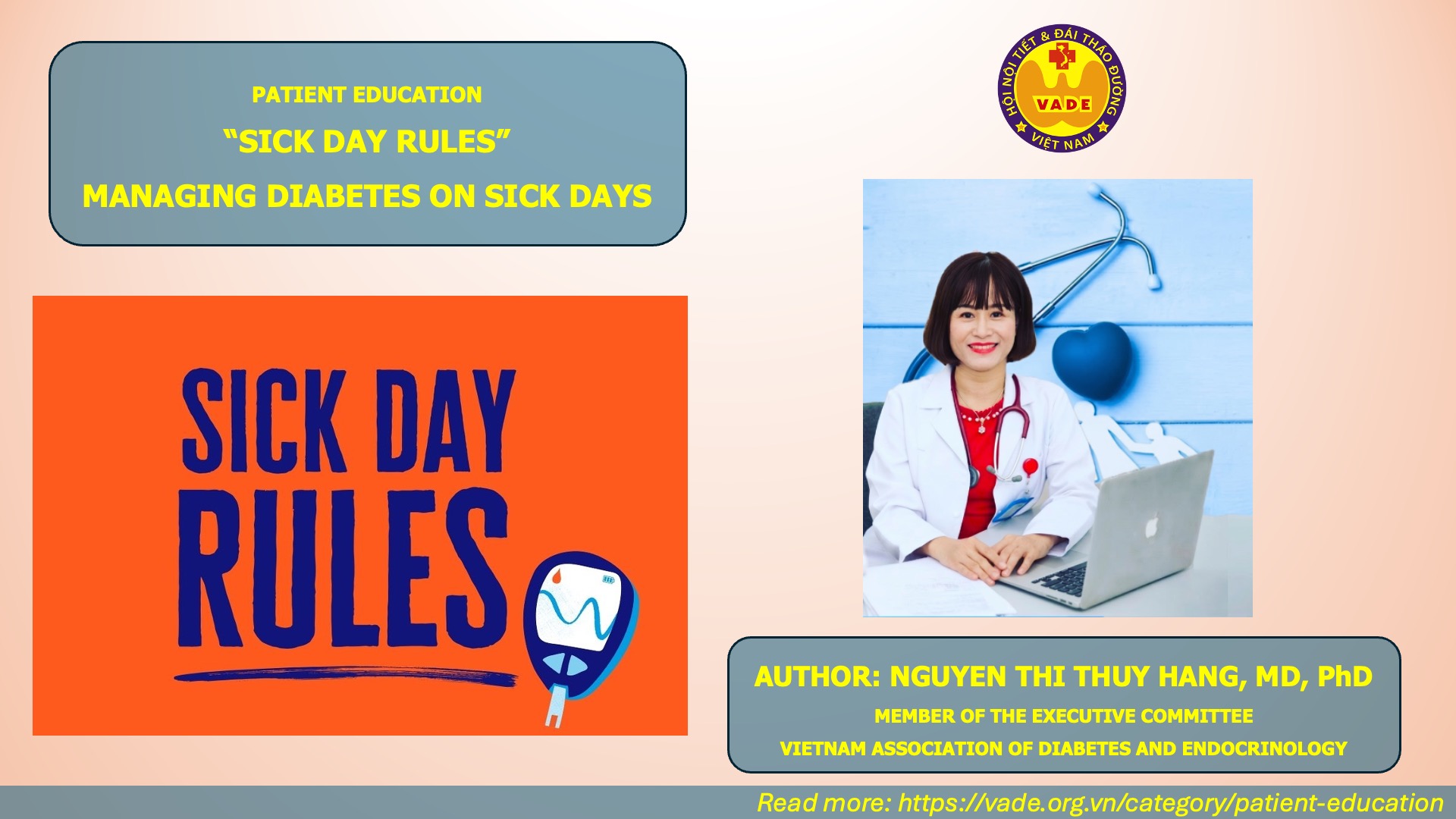
Nguyen Thi Thuy Hang, MD, PhD
When having a fever, flu, infection, vomiting, diarrhea, or poor appetite, blood sugar levels can rise or fall abnormally. Therefore, even when sick, patients still need to monitor and manage their diabetes.
1. Patients need to remember 5 main things
| What to do | How to do it? |
| 1. Monitor blood sugar more frequently | If you have a meter, you should check every 2–4 hours when sick or when your blood sugar is unstable. It is best to wear a CGM (Continuous Glucose Monitor). |
| 2. Drink plenty of water | Take small sips multiple times a day. If your blood sugar is high, prioritize filtered water or sugar-free drinks. |
| 3. Try to eat/drink a little | If you cannot eat rice, you can consume appropriate amounts of porridge, soup, milk, or fruit juice to avoid hypoglycemia. |
| 4. Do not arbitrarily stop insulin | People on insulin should not stop it on their own when sick. Dose adjustments may be needed as directed by a doctor. |
| 5. Know when to go to the hospital | If there are dangerous signs mentioned below, contact a medical facility immediately. |
Diabetes UK recommends that people with diabetes, when sick, should drink enough water, eat in small portions, monitor blood sugar more closely, and check for ketones when necessary.
2. Patients should consult their doctor about certain medications when sick
When experiencing vomiting, diarrhea, dehydration, high fever, or very poor appetite, patients need to ask their doctor/healthcare provider about temporarily stopping certain medications, especially:
- Metformin
- SGLT2i medications: dapagliflozin, empagliflozin, canagliflozin…
- Sulfonylurea medications: gliclazide, glimepiride, glibenclamide…
- Diuretics, ACEi/ARB blood pressure medications, NSAID painkillers if dehydrated
People taking SGLT2 inhibitors need to pay special attention because this class of drugs can be associated with diabetic ketoacidosis, even when blood sugar levels are not excessively high. Sick day guidelines for type 2 diabetes recommend checking ketones if you are taking an SGLT2i and become ill.
3. Danger signs requiring medical attention/emergency care
A. Suspecting Diabetic Ketoacidosis — DKA
Seek medical attention immediately if you have:
- Nausea, severe vomiting
- Abdominal pain
- Excessive thirst, excessive urination
- Extreme fatigue, drowsiness, confusion
- Rapid, deep breathing
- Fruity/acetone breath odor
- Elevated blood ketones
If blood ketones are over 3 mmol/L or urine ketones are 2+ or higher, the NHS recommends calling an ambulance or going to the emergency department as it could be DKA.
B. Suspecting Hyperosmolar Hyperglycemic State — HHS
HHS is more common in people with type 2 diabetes, especially older adults, those with infections, or those experiencing dehydration.
Seek medical attention/emergency care if you have:
- Persistently very high blood sugar
- Intense thirst
- Excessive urination, followed by potentially decreased urination
- Very dry skin, dry mouth
- Extreme fatigue, profound weakness
- Confusion, slurred speech, drowsiness
- Seizures or decreased consciousness
Diabetes UK states that common signs of HHS include excessive urination, extreme thirst, nausea, very dry skin, severe fatigue, confusion, drowsiness, and a gradual loss of consciousness.
4. Easy-to-remember guidelines for patients
When sick: check blood sugar frequently, drink plenty of water, try to eat/drink a little, do not stop insulin on your own, and seek immediate medical attention if there is severe vomiting, dehydration, persistently high blood sugar, elevated ketones, confusion, or drowsiness.
5. The shortest message
Being sick does not mean stopping diabetes management. The sicker you are, the more closely you must monitor your blood sugar.
References
1. Management of Hyperosmolar Hyperglycaemic State (HHS) in Adults: An updated guideline from the Joint British Diabetes Societies (JBDS) for Inpatient Care, Diabet Med 2022 Dec 21;40(3):e15005. doi: 10.1111/dme.15005, Omar G Mustafa1,2, MasudHaq3, Umesh Dashora 4, Erwin Castro 4, Ketan K Dhatariya 5,6,✉; the Joint British Diabetes Societies (JBDS) for Inpatient Care Group
2. What are the key clinical features to identify Hyperglycaemic Hyperosmolar State (HHS) in a patient with Type 2 Diabetes?
3. Hyperglycemic Crises in Adults With Diabetes: A Consensus Report. Diabetes Care, 2024.
4. Hyperosmolar hyperglycaemic state: A systematic review of management guidelines and their evidence, Rose Lin, Elizabeth Wootton, Michele Gaca, Balasubramanian Venkatesh, Rinaldo Bellomo, Elif Ekinci, 26 January 2026. https://doi.org/10.1111/dme.70226